Tyranny of the Mind

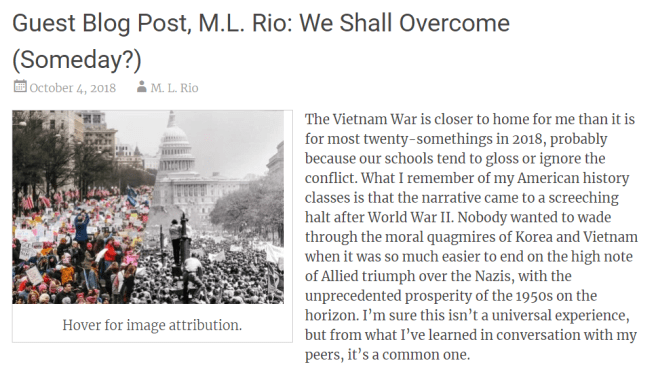
I’ve always been a sucker for a melodramatic title. You’ll have to forgive me for this one, which jumped to the tip of my tongue this morning as I reviewed the work I did yesterday and considered my half-formed plan for today. I stuck it in the title bar of this post as a placeholder, but the more I thought about it the less I wanted to change it, because it’s a prime example of exactly what I wanted to talk about. Why was this phrase bouncing around my brain in the first place? Because I’ve spent a lot of time with mid-century reflections on the failings of the democratic system lately, because that’s what the characters in my current WIP are doing. “Tyranny of the masses” is something they’ve talked about in the context of political protest and opposition to the Vietnam War. Certainly relevant to the current political climate, but the more mundane truth is it’s on my mind because it’s on their minds, and writing a first draft is like the full immersion approach to a foreign language. If you want to be able to speak it, you’ve got to live in it.

This “full immersion” approach isn’t unique to writing (other artists and professionals can certainly attest to a similar sort of monomania) but rather characteristic of it–at least for me. It’s a bit like method acting. You have to climb inside a character’s head and crawl back out through their mouth and that’s about as intimate as you can get with another person, fictional or not, so it isn’t surprising that the writer rarely emerges unaltered. At the risk of sounding like a crazy person, I’ll admit that when I’m working on a manuscript (which is always) my entire life revolves around it in a way which might be undetectable–not to mention uninteresting–to friends and family, who probably interpret it as just another peculiarity of my personality. In a way, it is that, but the ubiquity of it is hard to explain. What book or even what chapter of it I’m working on dictates not only what I’m reading, but what music I listen to, what drink I make when five o’clock rolls around, even how I get dressed in the morning. As obsessions go it’s a bit embarrassing–kind of like the unpleasant recollection of that awful band you were in love with in your middle school emo phase–so I don’t talk about it much, but neither can I turn it off.

Two weeks ago I explained how and why I’m making it a priority in 2019 to find a better work-life balance. I have made some small progress in that regard; I have checked my own impulses to get back to work when I’ve been “idle” for longer than fifteen minutes and made a pact with myself that I won’t do academic work on Saturdays. But the fact remains that work is my default setting. Yesterday I obeyed the ban on academic work, but instead I sat down and wrote for ten hours. I got 4,000 words down on paper, re-configured the end of my outline, took a break to eat dinner, and finally turned my computer off in an attempt to mark the end of work for the day. Then I scribbled out four more pages by hand. When I went to bed it took me three hours to fall asleep because I was rolling over every ten minutes to jot down notes and ideas and phrases too good to forget. (In the morning some of it doesn’t even make sense–for instance, the note which simply says “blanket”–but in the moment it all felt terribly urgent.) Today is another snow day, and I would be lying if I said I won’t spend it doing more or less the same thing.

This sort of obsessive-compulsive service to a story can sometimes engender an uncanny feeling that your life is not entirely your own. It’s a strange limbo to live in, but I’m often hesitant to talk about it because of how melodramatic, how ironically self-important it sounds. (Indeed, how many of you have had that thought while reading this post? Probably more than a few. I know and I’m sorry.) In my defense, this hyperfixation on my own work has nothing to do with delusions of grandeur and skewed expectations of how important to the larger world it actually is. If anything it’s the opposite; I’m fully aware that nothing I’m writing will ever matter as much to anyone else as it does to me; I’ve spent entire years of my life (not to mention money) working on manuscripts that will never be published and never earn me a dime, so I have no illusions on that score. That’s precisely why it’s so hard to come to grips with this particular obsession. In the greater scheme of things, I know exactly how little it matters. The worst thing that happens if this book doesn’t get written is that the book doesn’t get written. Even if it does, it’s quite possible nothing will come of it and I will have nothing to show for it except a few more lost years and spent money and a weirdly encyclopedic knowledge of a cultural moment nobody else is particularly interested in. And yet, at the same time that it feels vaguely depressing and pointless, it also feels tyrannically important and impossible to refuse.

At the risk of sounding, once again, melodramatic, I truly don’t remember what I thought about in otherwise unoccupied moments before I started writing. That could be because I started writing rather young and the gray matter which stores my story ideas has simply sloughed off everything inessential from those awkward early years in a psychological self-defense maneuver. But the question remains: what the hell do people who aren’t living with one foot in a fictional world think about when they’re walking the dog, taking a shower, folding laundry, doing all those normal human things which require little enough attention that the mind is free to wander? This is what I mean by work being my default setting; it’s my brain’s automatic screen saver. When there’s nothing else to occupy it, that’s where it goes; it chews on plot problems and tricky bits of dialogue and wonders which darlings to murder to drive the wordcount down. Perhaps more alarming, without the several dozen novel projects which have obsessed me at different intervals over the last fifteen years, I have absolutely no idea who I would be.

Yesterday, besides chipping away at a first draft for the better part of ten hours, I also found some time to finish the book I was reading, Hermann Hesse’s Journey to the East. (Why that? Because it’s on that list of books the characters in my WIP would probably be reading. All roads lead to Rome.) Like the rest of Hesse’s books, it’s abstract and baffling and disquieting precisely because you never know quite what he’s getting at but you’re not sure you’d like it if you did. However, Hesse does have a helpful tendency to repeat the important ideas, and one of them struck particularly close to home: “We had talked about the creations of poetry being more vivid and real than the poets themselves” (123).* I flipped back to the earlier conversation this morning and felt a flutter of déjà vu, because the suspicion that “however animated and lovable the personalities of these artists were, yet without exception their imaginary characters were more animated, more beautiful, happier and certainly finer and more real than the poets and creators themselves” was uncomfortably familiar (32-3). It’s a strange experience to pick up a book and find an unflattering portrait of yourself inside.

So, what’s the point of this post? I don’t know. What do you do with the realization that your creative workaholism is the sum total of your personality?

You get back to work, I guess. But maybe that isn’t as depressing as it sounds (or maybe I just want it not to be, and what follows will be a transparent justification of my own neuroses). Maybe it’s simply proof of the human hunger for a better version of the world–something more exciting, more colorful, more important than what we encounter in our daily lives. That’s one of the reasons we read and it’s certainly one of the reasons I write. Believe me, I see the irony: in order to satisfy that craving for something exciting and profound I sat on my couch and typed for ten hours? Yes, laughably ironic. But I suppose one of the things I’ve never grown disillusioned about is the magic of what words can do, what a skilled writer who’s spent ten years at the desk can make them do, how they can cut you to the quick if you read them when the time is right. I don’t pretend to be one of those writers, but it’s not a bad ideal to chase.

I’m still working on the work-life balance thing. It’s hard to do when you’ve realized your life and your work are more or less interchangeable. But so long as writing remains a labor of love, I won’t worry too much. I don’t mind who writing has made me, even if it confuses the hell out of every MBTI test and Google algorithm trying to figure out how to categorize me. Joke’s on you. I contain multitudes.

M


* Herman Hesse, The Journey to the East, trans. Hilda Rosner (New York: Bantam, 1972).

Time is a Construct, but New Beginnings Are Nice

Like most sane people, I’ve never set much stock in new year’s resolutions. They’re usually overly ambitious, often the remedy for some perceived personal failing, and nearly always forgotten by February. However, there’s something to be said for taking a moment to reflect at the start of a new year and ask yourself what you could be doing differently—whether you’re interested in improving yourself or your quality of life or some combination of the two. I think writers are particularly prone to that impulse, as beings constantly in search of improvement and, more importantly, reasons to keep at it. Writing is hard. Publishing is harder. Trying to juggle either (or both) with another job—as all of us except the very luckiest have to do—can result in feeling a bit like Sisyphus, struggling to push a boulder up a mountain only to watch it roll back down to the bottom again. This is part of the reason most writing resolutions I see make me sigh in a sad, cynical way, shake my head and go back to my coffee. You’re going to write 3,000 words every day this year? Sure, Jan.

However, there’s no ignoring the fact that the way I worked the last six months is completely unsustainable. There wasn’t a whole lot I could do about it—it was just a uniquely crappy combination of uniquely crappy circumstances which resulted in my working about sixteen hours a day, every day, because that was the only way everything was going to get done. (And still everything didn’t get done. One of my mentors kindly agreed to extend one of my deadlines until February, an unlooked-for stay of execution.) As any of my friends who have patiently endured my endless bitching about the situation would attest, I was miserable. The way I described it to someone was “tiptoeing along the edge of a nervous breakdown.” It is not easy to do good work when you’re living that way.

But enough of the pity party. The point of this post—the first in very long while, and I’m sure it’s no mystery why—is not simply to whine into the ether, but rather to start 2019 on a positive note. Which, frankly, feels like an act of defiance in and of itself, given the way 2018 went. I still don’t really believe in resolutions, but I do believe in setting realistic goals with a gameplan and a timeline to achieve them. So here’s what I’ve got in mind for 2019:

1. Find a better work-life balance.

Writing and academia are both fields where a culture of overwork is normalized and often romanticized. Add to that the fact that I have always been a fiercely ambitious person, and the result is a lot of days where I only stop working long enough to shower and eat and even when I’m doing those things I’m probably brainstorming, trying to think my way out of a plot hole or twist a troublesome thesis statement into better shape. It’s not a healthy way to live and it’s not a healthy way to work. I don’t like that I’ve become the sort of person who gets anxious when they aren’t working towards finishing a specific task—which might seem ironic, given the nature of this list. However, precisely because I’m so task-oriented, I am assigning myself the task of doing something I enjoy every day without worrying about how “productive” it is. I am giving myself permission—and a direct order—to relax.

2. Multi-task less.

Not to brag, but I am awesome at multi-tasking. I can listen to music and read a book and do laundry and eat lunch and play with the dog and keep tabs on two different group chats and three different email accounts all at the same time. It often feels like the only way to get everything done. But dividing my attention between four different things (or five, or six, or whatever) often leaves me feeling like I haven’t really engaged in a meaningful way with any of those things. I’m not too worried about having a meaningful relationship with my laundry, but I would like to spend more time doing only one thing at a time, and devoting all of my attention to that thing—even if it’s one of those non-productive enjoyable things, like reading for pleasure or listening to music. As Ron Swanson might put it, “Never half-ass two things. Whole-ass one thing.” That’s my new mantra for 2019.

3. Get more organized.

Anybody who knows me might find this kind of a strange objective, as I’m not really what you’d call disorganized. I usually know exactly what my deadlines are and how much work I have to do each day to meet them. I outline fanatically, I love lists, and I have five different calendars color-coded in such a way to make Leslie Knope swoon. But that’s not really what I’m talking about here. I’m talking about organization in a more abstract sense. I want to get my ideas and priorities better organized. I want to think more about the big picture instead of focusing myopically on the daily minutiae. I want my headspace more comfortable and less cluttered. I don’t really know how to do this. It may be as big as trying to articulate those ideas and priorities or as small as trying to check my obsessive impulses and ask whether I’m missing the forest for the trees. “Detail-oriented,” contrary to what every job interviewer ever seems to think, is not always an indisputably good thing.

4. Follow my own advice.

I’m constantly telling young(er) writers that writing isn’t a race and that they should pump the brakes and slow down and stop panicking about not having a book deal at age 22. And yet, I have wasted a lot of energy worrying that my career isn’t moving fast enough or as fast as I want it to while we chase that notoriously difficult second book deal. I think it comes back to a deep fear that this is as good as it gets—a vague, muffled terror that I peaked at 25 and I’m never getting another book published and I’ll never be able to get a tenure-track job and I’ll probably die alone surrounded by unpublished manuscripts and rejected grant applications because I was so freaked out by the possibility of Failure-with-a-capital-F that I worked like a lunatic and left myself no time for any sort of personal life. (Thanks, capitalism.) That is, frankly, ridiculous and I am calling myself on my bullshit. Why do I think I’m exempt from all the reassuring truisms I tell my friends when they have the same concerns about life? I’m so quick to tell other people they’re smart and capable and full of potential and life doesn’t have any deadlines. I need to work on saying those same things to myself—and believing them.

5. Stay ambitious.

Just because my quality of life needs some serious improvement and I need to ameliorate my workaholism and I want to take some of the unnecessary pressure off myself doesn’t mean that I can’t still hunt down those big game goals. I have a lot of plans for the year ahead. I want to take a pretty epic research trip. I want to get another manuscript to my agent and I want it to be my best work yet. I have a couple of short stories I want to write or finish (and maybe even submit somewhere). I want to write more nonfiction, spend more time cultivating my voice as a person instead of my voice as a narrator of someone else’s story. I want to produce some articles and conference papers and knock my comprehensive exams out of the park. But I want to do all that stuff without punishing myself for falling short of impossible expectations. I want to find a balance between ambition and enjoyment and not beat myself up for wanting that balance. Because what’s the point of all this productivity if you don’t have time to enjoy what you’re producing? I refuse to fall into that quicksand again this year.

I don’t know if this list—odd and intensely personal as it is—will be helpful to anybody else. I don’t even really know if it will be helpful to me. But getting my thoughts about all this (figuratively) down on paper is, I think, a step in the right direction. I’m not going to make any sweeping declarations about what a great year it’s going to be or how it can’t possibly be as bad as last year, because both of those things seem unlikely or outright delusional, just given the way the world is turning. Instead I’ll just say I’m as ready as I’ll ever be for 2019. Bring it on.

I wish you the best balance of ambition and enjoyment in the year to come.

Xx M

Signing 12/1

Good news if you’re in the MD/DC area–my signing with Howard County Library has been rescheduled, and I’ll be at the Miller Branch on December 1. Hope to see you there! More info here.

P. S. Signed books make great Christmas gifts.

–M

Guest Post

This week I had the opportunity to share some thoughts with Superstition Review about politics, writing, what I’m working on, and making art in the age of Trump.

SR.png

The full post is here, and I hope you take a few minutes to read it.

–M

Waterstones Book of the Month

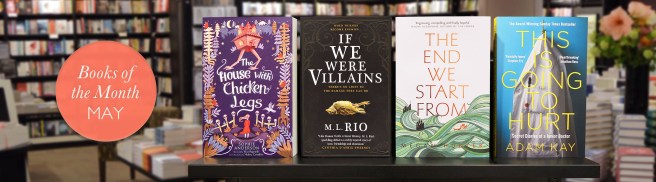
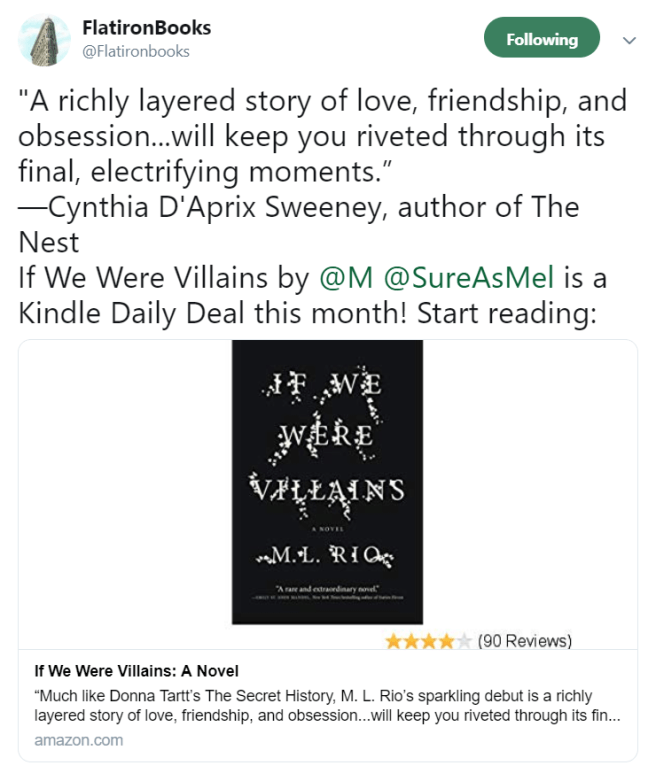
So excited to share that Villains has been chosen as Waterstones’ Thriller of the Month for May! It’s on sale for UK readers, so now’s the time to grab it.

WaterstonesBotM

From the Waterstones website:

If We Were Villains teases out a story of a close-knit coterie poisoned by a seed of passionate rivalry. As play spills over into something much more sinister, the scene is set for unspeakable acts. As darkly compelling and tautly plotted as any Shakespearian tragedy, M. L. Rio delivers a haunting debut of blood-sworn friendship, dangerous obsession and murderous intent.

Happy reading across the pond!

–M