
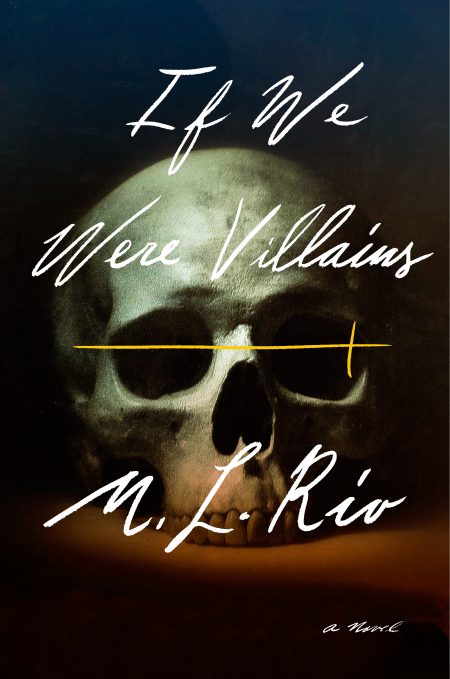
Just a reminder. It’s almost here.
Just a reminder. It’s almost here.
Over the past week, my agent, my editor, and I have been collecting your questions about books, publishing, and If We Were Villains. You can read the first round of answers here, and the second round below (but first a quick reminder who we are):
Arielle Datz is a New York transplant from Los Angeles, who started as an intern at Dunow, Carlson, & Lerner Literary Agency in 2011. She then worked in the foreign rights department at WME, followed by the Elizabeth Kaplan Literary Agency. She returned to DCL full-time in 2015. She is currently obsessed with April the Pregnant Giraffe (aprilthegiraffe.com). Other loves include whales, contemporary chamber music, and noodles in all forms.
Christine Kopprasch is an Executive Editor at Flatiron Books, where she recently published New York Times bestsellers The Dry and Behind Her Eyes. She is publishing the upcoming debuts If We Were Villains and Tornado Weather. Christine previously worked at Crown, where her acquisitions included New York Times bestseller Bittersweet, New York Times bestseller The Little Paris Bookshop, and The Vegetarian, which won the Man Booker International and was a New York Times Top 10 Best Book of 2016. Christine is a terrible but avid gardener and an obsessive reader. She has a baby at home, so she basically hasn’t slept in a year. (Her opinions are her own.)
M. L. Rio is the author of If We Were Villains, coming to a bookstore near you on April 11th from Flatiron Books. Before she was an author she was an actor, and before she was an actor she was just a word nerd whose only friends were books. She holds a master’s degree in Shakespeare Studies from King’s College London, and probably won’t break away from the cult of academia any time soon. Her other favorite things include music, wine, and her dog Marlowe.
And without any further ado, our next questions from you.
For Arielle/Christine: What did you study and when did you realize this is what you wanted to do?
A: I majored in English literature, and knew when I graduated that I wanted to pursue a career in publishing, although at the time I didn’t know which part of publishing. After interning and working at a few literary agencies, I realized that I enjoyed the relationship that agents have with authors and the role that we play in the publishing world.
C: I was an English major with a Women’s Studies minor. English was a natural fit for me because I loved reading, and I interned at a literary agency when I was in college because I thought publishing might be interesting. That wasn’t a positive experience, so I actually ended up assistant teaching third and fourth grades for two years before I interned at another literary agency and got my first editorial assistant job. I always thought I would like to work with books. It’s the kind of job that people who knew me in elementary school say, “Of course!” when they hear what I do – I was always obsessed with books and writing, and I delighted in tinkering with other people’s words. I’m lucky I have the chance.
For C: 1) What types of editors are there, and what are their roles? I know of acquisitions editor and manuscript editor, but I am not quite sure what they entail. 2) What kind of education is looked for in editors? I’m interested in becoming and editor, and I know where to start. Should I shoot for an MA or is a BA fine? Also, how do I get my foot in the door at big publishing companies? What do companies look for in editors? What entry level jobs are there for me to pursue?
C: 1) I am the “editor,” full stop, in US parlance, as I both acquire and edit the manuscript. I think this may differ by country, as some UK houses have a separation between the two jobs, but I’m not sure about the details. Broadly: to acquire, I read about 500 submissions a year (or parts of them) and sort through what I like and think readers will like. To edit, I go through the manuscript very carefully and give the author my thoughts about what is and isn’t working.
2) I can go on about getting a job in publishing for too long. Real talk: It’s hard! BA is fine. I spent 6 months unemployed while I tried to get interviews in publishing, so I did an unpaid internship at a literary agency to help me connect with people in the industry. Having someone who knew me recommend me directly to the editor who was hiring was much more effective for me than going through HR. That’s not possible for everyone, of course, depending on where you live in the world and finances. I saved up on my tiny teacher’s salary so I could have some flexibility, and I had parents who lived within commuting distance of the city so I could get in for interviews and internships without committing to an apartment before I had a job.
The entry-level jobs are mostly for assistants who will do a lot of administrative work for years. They aren’t glamorous or easy! I was highly motivated (and I had a great first boss), so I was devoted to proving myself. I stayed up late reading as many of my editor boss’s submissions as I could, sending her my thoughts about what I was reading. I told her what to read first, what I didn’t love but thought she might because I knew her taste, and why I would reject the rest. I also read her edits and paid attention. She was brilliant and I would read every note she had for an author. Then I started “editing behind” her: after she was done editing a book, I would go through it and see if I had other thoughts she might find helpful. She was kind enough to not only consider and use my thoughts, but also to tell the agents & authors when a suggestion had been mine, which increased my credibility with them. (And when she left and her projects were reassigned, the agents and I could make a credible case for why I should keep the books.) Companies are looking for someone who reads widely and deeply, is fanatically interested in supporting an editor by doing lots of tiresome, often thankless work (forms, copying, mailing, setting up meetings, scheduling lunches, drafting rejections, contract requests, system admin) and adding the editorial work on top of that.
I was focused on the editorial path, but if you’re not totally sure if that’s for you, there are lots of other jobs in books to consider: working on covers or interior designs if you’re artistic, working on the accounting side if you’re math-minded, working in publicity if you like pitching books to people you don’t know, working in marketing if you are business-minded, etc. And there’s also the agenting side. All of these people are important in the process, so you don’t have to be an editor to work with books.
For C:When editing a manuscript do you only focus on things like structure, character, theme etc. or also on the language? I mean this in the sense of getting the words right or saying “I don’t think these specific words work here”.
C: All of those things! I tend to look at the big picture issues first, because there is no point in line editing chapters that may change substantially. By the final round I usually have a lot to say about specific words and phrases. For example, I always keep a running list of words that have jumped out at me as possibly being overused. What language I think needs editing depends on the manuscript, of course. M is such an editing expert (if I may brag on her a bit!) that Villains had already been through many, many drafts when I first read it, and she had picked up on many of her own quirks and addressed them. Not only did that make it fun to read, but it left me free to notice different things than I might have if more obvious issues needed to be addressed.
For A/C: Since upmarket fiction is a bit of a “combination”: what are you more likely to be interested in, a manuscript with great characters whose plot needs some work or one with a strong plot where the characters need tinkering? Or do you feel that if either of those still need work then the story isn’t worked out enough yet, although I guess there’s always room for improvement?
A: I don’t have a clear answer for this. When I read a manuscript, if I fall in love with it, I’m willing to do the work on it. If I can find a way in, then I will try to work with the writer to realize that book’s potential.
C: It’s easier to fall in love when both characters and plot are there, but if I have to choose, I’m more likely interested when the plot needs work. I just acquired two very different books that each had wonderful characters that leapt off the page, but both needed major plot changes (in my opinion). One was brilliantly written and conceived but didn’t yet have the page-turning momentum that makes you race through a book, and the other’s central mystery didn’t yet make the best use of the amazing main character. I think they will have both of your listed attributes once the authors and I are finished with them! Even if a book isn’t quite working for me, a strong voice can keep me interested in thinking about whether I have plot ideas to contribute.
For C: For an as of yet unpublished author who’s work leans toward the literary end of the spectrum what is the best way to attract the attention of a mainstream publisher? I’ve read alot and it seems to be a combination of published submissions and contest wins which result in a literary agent which THEN results (maybe) in a book deal. How do you go about getting a publisher to invest time and money in your project? I’m not ready to publish yet (I need to improve) but when I am, how?
C: Yes, published submissions and contest wins can help you get noticed. But where I’ve worked, it really is almost all about the book on submission. If you have great credits to your name, I might decide to read that submission before something else in my pile, but in the end the only thing that really matters to me is what’s on the page. Not platform or previous publications, just how I feel when I’m reading. If I can’t put it down, that’s the best way to get my attention.
For A/C: What makes a manuscript stand out to an agent or publisher? What stood out in the case of IWWV?
A: There’s no right answer for the first part of your question. Every agent and publisher has their own unique taste, so what makes a manuscript stand out depends on the reader. For IWWV, I started reading and got immediately sucked in, and then as I kept reading my excitement for the book and about the book just grew. I can’t point to a specific thing and say, “That right there, that did it.” It’s more that, as I read, I felt energized and electrified. I’d compare it to feeling a crush for the first time.
C: Well, I don’t even think M’s ever seen this, but here’s part of the note I sent to my boss before I’d finished IWWV to tell her I was loving it and wanted the team to read with me: “I feel like it’s really smart without being pretentious, suspenseful without feeling fake, and a great friendship & coming of age story. It helps to know Shakespeare but even without being an expert it is very compelling.” Not only did the plot and conceit stand out, but also the manuscript was so clean and sharp and carefully crafted that I knew the author was someone I wanted to work with. Every word had been scrutinized, which I could tell only because the read was so effortless. And I love a book that assumes readers are intelligent and intellectually curious.
For A/C/M: How long did the whole process take, from starting to write IWWV to deciding it was ready for publishing?
A: Let’s see: for IWWV, M and I started working together in March 2015, and we did a few revisions before I felt ready to submit to publishers. Flatiron acquired it in June 2015, more revisions were done, and here we are with publication fast approaching.
C: I got the submission in June 2015, so I’ve been involved with it for coming up on two years.
M: It was definitely a longer process for me, because I worked on the manuscript for about a year by myself before Arielle came into the picture, and then a few months later, Christine. I’ve been working on this thing since just about this same time in 2014. So, three years in the making for me.
For A/C/M: What was the most troublesome or difficult part of the publishing process? Like, were there any unexpected bumps in the road?
M: I think with any creative project that takes place over the course of two years or more, you’re bound to hit some unexpected bumps. Actually the timeline was a bump in and of itself. Our original release date was in January 2017 and I don’t mind admitting that I was a little bit heartbroken when I heard we were going to have to push it back to April. Down the line I completely understand why we decided to do that and I do think it was the right call—I mean, nobody buys books in January because they all just got books for Christmas—but at the time it felt like a whole lifetime longer to have to wait. I will also admit to being the lone dissenting opinion in the cover art conversation. But that’s part of the beauty and also the challenge of having so many people work on one piece of art: there are bound to be things not everyone agrees about.
A: Speaking to what M said, I think one of the hardest parts of the publishing process (especially for a first time author), is reconciling the dream of a book with the realities of the publishing industry. Compromises are inevitable, but that doesn’t make them easy. Ultimately the author, agent, and editor/publisher all want to create the best book possible, but unfortunately agreeing on what that actually is can mean some difficult conversations.
C: I always try to share my major editorial ideas with an author before I buy her book, so she doesn’t get shell-shocked later. But if I’m remembering correctly, my biggest suggested change to Villains came out of my third (or so) reading of the manuscript. Luckily M jumped on it, but as I was sending that letter I did wonder what she would think about this rather significant plot change we hadn’t previously discussed.
We have many more questions in the queue, so keep an eye out!
Over the past week, my agent, my editor, and I have been collecting your questions about books, publishing, and If We Were Villains. Here’s the first round of answers from me and Arielle (but first a quick reminder who we are):
Arielle Datz is a New York transplant from Los Angeles, who started as an intern at Dunow, Carlson, & Lerner Literary Agency in 2011. She then worked in the foreign rights department at WME, followed by the Elizabeth Kaplan Literary Agency. She returned to DCL full-time in 2015. She is currently obsessed with April the Pregnant Giraffe (aprilthegiraffe.com). Other loves include whales, contemporary chamber music, and noodles in all forms.
M. L. Rio is the author of If We Were Villains, coming to a bookstore near you on April 11th from Flatiron Books. Before she was an author she was an actor, and before she was an actor she was just a word nerd whose only friends were books. She holds a master’s degree in Shakespeare Studies from King’s College London, and probably won’t break away from the cult of academia any time soon. Her other favorite things include music, wine, and her dog Marlowe.
And without any further ado, our first questions from you.
For Arielle: Are there some things that you encounter in query letters that immediately or always make you turn them down (apart from people not following instructions)?
Arielle: People not following instructions is a big one. But more generally, if it’s clear the writer didn’t do any research on me (check out my bio on our website, maybe check my Twitter or IG, where I often say what I’m reading and loving, and it’s easy to get a sense of what I’m into), that’s a turn-off. On a smaller scale, if there are grammatical errors in the first lines, I tend to be out. This may seem trivial, but usually it’s indicative of the writing style. Some agents (and an agent is also an editor) can see the potential past sloppy writing and are willing to work with the writer to clean it up, but I get easily lost in the fog of errors to see the story. Careful writing in the query letter shows me there will be careful writing in the manuscript.
For A/M: Is it better to find an agent or send your manuscript straight to a publishing company? I’ve heard opinions on both sides so hearing pros and cons from the professionals would be fab. How do you go about finding an agent? No one ever talks about this mystical part of the publishing process, and I’d like to figure it out before I reach that point. How did you do it, how do agents suggest you do it?
M: I think I’ll let Arielle take the first half of this one, but as for how to find an agent, I can’t stress how important it is not to query at random. When you’re sending query letters you want to take a couple of things into account, which include but aren’t limited to the size of the agency (a bigger agency may have better contacts but you’ll get less attention), what their ‘mission statement’ is, and most importantly, whether they represent the kind of stuff you write and whether they’ve had success selling it. Once you’ve figured that out, you need to look at what specific agents are interested in and be able to articulate why they might be interested in your work. For instance, it doesn’t make any sense to send a query for romantic high fantasy to an agent who’s only looking for middle grade mysteries. Finding an agency is all about fit, so if you can’t say why you’re querying a specific person, you probably shouldn’t be querying them. Last but not least, don’t send query letters to agents who aren’t taking submissions, because that just wastes everyone’s time. The most important thing if and when you do finally get an agent on the line is to make sure your visions for the book are compatible. I talked to a few different agents about representing Villains, but when I spoke to Arielle I could tell she just got it. She knew exactly why the story mattered, I think partly because she grasped the fact that the precarious age of these characters is really important–that strange liminal place between adolescence and adulthood. Some of the agents I talked to wanted to make everyone older or younger so they fit in a more clearly defined category. Arielle understood that their not fitting clearly into one category or the other was precisely the point. Sharing a vision with your agent is really important. As another agent friend said to me when I was weighing my options, “Who do you want talking about your book when you’re not in the room?” It can be tempting to jump on the first agent who expresses an interest, but it’s much better to wait for an agent who’s really the right one.
A: In a broad sense, if your ambition as a writer is to be published by a mainstream publisher, then you need to have an agent. The big publishers generally don’t take submissions that don’t come from an agent, because they don’t have the capacity to field that many submissions. Moreover, an agent acts as a gatekeeper of sorts; it’s an agent’s job to have good relationships with publishing houses, so that they only get bombarded by us with submissions (and they know us, and we know each other’s tastes), rather than by every writer in the world. That said, some small, independent publishers and presses do take submissions from writers directly, and should indicate as much on their websites. As M says, research is key. There are tons of online resources with information on agencies and publishers, so you can begin to figure out which path is right for you, and which agencies or agents you think you would work well with.
For A/M: Do you have to live in a big city to get traditionally published?
M: Nope. When we sold Villains I was living in a small college town in North Carolina. Because most communication in publishing happens either online or over the phone, your physical location is pretty much immaterial.
A: What M said!
For A: What would you advise someone who does not live in an English speaking country to do differently when hoping to find a literary agent? Is it possible at all for, say, people living in Germany to gain the attention of an English/American agent?
A: This is a little bit out of my wheelhouse, but I do have some experience with foreign rights (i.e., selling translation rights for English books into other languages), and I imagine it works in a similar way. My impression is that there are agents in pretty much every country/language, and they should have resources and connections in the English-speaking world. Using your example, I would recommend looking first for a German agent, who would hopefully have the connections to get an English-language agent’s attention. However, it also depends on what language you’re writing in – if you have a manuscript that is written in English, and you just happen to be German, I’d say go ahead and submit to English-language agents. However, if the manuscript is not yet translated, that can be a barrier (and a good reason to get a German agent first). Simply put, it’s certainly possible, but a bit more complicated.
We have many more questions in the queue, but don’t forget you still have two more days to send them in–so if you have questions about writing, agenting, editing, or Villains, ask them soon! All the info you need lives right here.
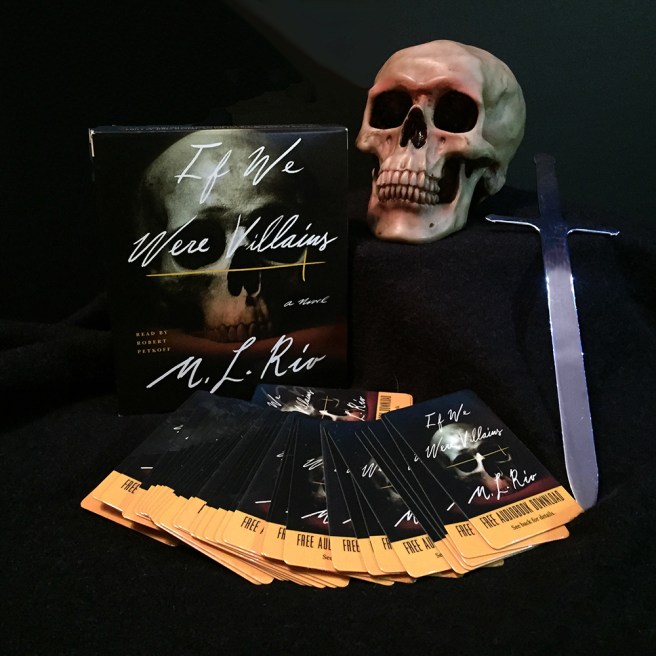
Want to win a free digital download of the If We Were Villains audiobook? Macmillan Audio is running a giveaway, and you can enter here.
Good luck!
In the past few weeks, as we get closer and closer to a release day for Villains, I’ve shared a number of conversations with my agent and editor about the enthusiasm for publishing online, and the lack of inside information available. And they’ve offered to do something amazing:
They’re going to answer all your questions about writing, editing, agenting, and the process of publishing If We Were Villains.
Here’s a little bit more about them:
Arielle Datz is a New York transplant from Los Angeles, who started as an intern at Dunow, Carlson, & Lerner Literary Agency in 2011. She then worked in the foreign rights department at WME, followed by the Elizabeth Kaplan Literary Agency. She returned to DCL full-time in 2015. She is currently obsessed with April the Pregnant Giraffe (aprilthegiraffe.com). Other loves: whales, contemporary chamber music, and noodles in all forms.
Christine Kopprasch is an Executive Editor at Flatiron Books, where she recently published New York Times bestsellers The Dry and Behind Her Eyes. She is publishing the upcoming debuts If We Were Villains and Tornado Weather. Christine previously worked at Crown, where her acquisitions included New York Times bestseller Bittersweet, New York Times bestseller The Little Paris Bookshop, and The Vegetarian, which won the Man Booker International and was a New York Times Top 10 Best Book of 2016.Christine is a terrible but avid gardener and an obsessive reader. She has a baby at home, so she basically hasn’t slept in a year. (Her opinions are her own.)
This is an incredible opportunity to hear from some people (besides me) in the book business firsthand, so please take advantage of it! Here’s how it’s going to work:
We’ll be accepting and posting questions up until April 4th, which is one week before the Villains release, so go ahead and start sending them in!
Can’t wait to hear from you.
You are the unsung hero of publishing. You are the last link between writers and readers. You matter more than you know. And you never get enough credit, so the first thing I really want to say with this letter is thank you—for every box you’ve unpacked, every book you’ve stacked, and every time you’ve been berated for explaining the difference between a bookstore and a Starbucks.
I used to be a bookseller. The year after I graduated college I worked four jobs in order to keep myself fed and caffeinated while I was writing a novel, If We Were Villains (which comes out on April 11th, two weeks from today). Bookselling was easily the best of the four jobs, because in between the unboxing and the book-stacking and the umpteenth explanation of why we don’t sell Amazon gift cards, I got to be on the front lines of fiction. That’s why any bookseller I’ve ever known started selling books to begin with. From the first day until the last, you get a little rush every time you persuade someone looking for a good read that one of your favorites might end up being one of their favorites, too.
Believe it or not, being an author is actually a lot like being a bookseller. Case in point, I’m about to try to sell you a book.
If We Were Villains is a book about books and the people who love them too much. It’s about art and passion and poetry and all those things that made me a reader. It’s also about ambition and danger and drama and all those things that made me want to write. It’s about being young and reckless and finding out the hard way what consequences really are. It’s about Shakespeare. It’s about death. It’s about academia. Most of all, it’s about words.
I love words. Chances are, you and I have that much in common. If we didn’t, I wouldn’t be writing this letter, and you probably wouldn’t be reading it. I hope you’ll read If We Were Villains and fall in love with the words inside. And if you do, I hope you’ll do a fellow bookseller a favor and push it into the hands of every customer who’s looking for something good.
On slow days at the bookstore, I used to wander through the fiction section and linger in the Rs, staring at the imaginary space between Rice and Riordan and saying to myself, “Someday your name is going to go right there.” For me, If We Were Villains is a daydream come true. But now, dear bookseller, I need your help to keep it alive. All I can offer in return is a chance to read this thing I wrote, and my eternal gratitude.
Once again, thank you, for everything you do.
Wishing you peaceful lunch breaks, hot coffee, and nice customers,
This is one of the things I most often get questions about, from the online community and real-world friends and acquaintances who learn my first novel is being published the old-fashioned way. And about six months ago I had an opportunity to talk about that, with Books Show Off 5 at the Tottenham Court Waterstones in London. I always meant to share some of that here, but never got around to it. With publication a mere eighteen days away (!) now seems like as good a time as any. So, from your friendly neighborhood debut author, here are 10 Steps to Getting a Book Published. They might not be what you think.
Step 1: Admit that there are way more than ten steps to getting a book published.
Let’s try that again.
Step 1: Have no friends in middle school. Spend all of your spare time reading until you realize that’s not enough anymore.
Step 2: Pick up a pen. Spend two years writing your ‘first’ book. Realize as soon as you finish it that it’s a pile of crap, shove it a drawer and never speak of it again.
Step 3: Keep writing. Write something new. Inevitably realize it is also crap, shove it in a drawer, and never speak of it again, but don’t give up because this time it was slightly less crappy crap than it was the time before and hey, that’s progress.
Step 4: Repeat Step Three for roughly ten years.
Step 5: Take creative writing classes in college. Have professors give you arbitrary rules like “You can’t use the word ‘nervous’” or “Don’t write about snow.” Abide by these rules because you’re nineteen years old and grades are more important than artistic integrity. Then have a professor tell you you’re not allowed to write a male narrator because that’s an experience you, with your feeble female mind, can’t possibly comprehend or do artistic justice to. Turn in your final story, with a female narrator this time, and be unsure whether to laugh or scream in fury when the same professor reads it and says, “Your narrator sounds like a man.”
Step 6: Realize that every rule you’ve ever been told about writing is actually just an arbitrary personal preference disguised as wisdom by a bunch of boring old white men who still worship Hemingway. Decide to make your own rules. Keep writing.
Step 7: Apply to do your senior honors thesis in the creative writing department. Get rejected, probably because you broke the rules. Keep writing.
Step 8: Graduate anyway with a BA in English and a minor in creative writing. Get so sick of the question, “What exactly do you plan to do with that?” that you start responding with “I was thinking of becoming a bum,” or “Right now I’m really enjoying my quarter-life crisis,” or “I got a great offer to join a cult last week. Can I give you brochure?” Whatever you do, don’t tell anyone you’re a writer. Because then they’ll want to know if you’ve ever published anything, and when you say “No, not yet,” they’ll give you The Look. That look which is somehow simultaneously knowing and condescending, as if they know that what you really mean when you say you’re a writer is that you write kinky Star Trek fanfiction that only gets published on WattPad and still live in your mom’s basement. Keep writing, but keep it to yourself.
Step 9: Spend a summer at the Iowa Writers’ Workshop and the Denver Publishing Institute. Talk about books and writing with a lot of people who are a lot smarter and more talented than you are and finally realize that the reason you’ve been writing crap for ten years is because you’re trying to write about stuff you don’t understand (and no, Professor, being female has nothing to do with it). Realize that there’s a grain of truth in the old adage ‘write what you know,’ because you know a lot more than you think you do—enough to make a story out of, anyway. Go back to Step 3. Write something new. Write something you know and as soon as you finish it, know that it’s different. It’s still crap, but it’s crap with potential.
Step 10: Get a job in a bookstore to support yourself while rewriting the Crap with Potential. Love your job, but daydream while you straighten the shelves, and linger in the Rs, telling yourself that one day your name is going to go right there. After your first few paychecks, accept that regardless of how great working in a bookstore is, it’s not nearly enough to live on. Get three other jobs. In the wee hours of the morning between getting off work at the wine bar and going back to work at the bookstore, keep rewriting. Keep telling yourself, “This crap has potential.”
Step 11: Apply to graduate school. Apply to ten MFA programs. Cross your fingers and send them a sample and hope they can see that it might be crap now but it has so much potential. Get rejected, again, by every single one.
Step 12: Actually have that quarter-life crisis you used to joke about. Wonder if this whole writing thing is just a pipe dream but keep writing anyway, because at this point it’s kind of like a drug and you can’t quit cold turkey. Put what’s left of your faith in the Crap with Potential. Do ten drafts in six months and when there’s nothing else you can fix, take a deep breath, and write the first draft of a query letter. Then scrap it and write fifty more drafts of that query letter, wondering how in the hell you’re supposed to turn your 110,000-word Crap Masterpiece into three paragraphs and somehow do it justice. Eventually, cross your fingers and hit ‘send.’
Step 13: Query 25 agents. Receive no response from most of them, a couple of polite “thank you but no thank you”s, one weirdly personal rejection, and finally get a nibble. Schedule a phone call. Talk to a real live agent who actually read your book, actually loved it, and actually wants to represent you. Try not to say anything nuts that might scare her away, all the while secretly screaming on the inside. Reach an agreement. Say how excited you are to work with each other. Hang up the phone and burst into tears.
Step 14: Go meet your agent in New York. Feel like a real writer for the first time. On the way out of the restaurant, have her turn to you and say, “By the way, we’re going to have to change your name.” Ask why and find out that you have the same name as a Colombian porn star. (Realize much later that this should have been your first hint that pretty much nothing in publishing goes according to plan.) Do revisions with your agent’s input. Be thrilled to have someone involved who actually knows what they’re doing and try not to draw too much attention to how totally clueless you are.
Step 15: After a few months, decide that the book’s ready for submission. Try to take your agent’s advice to heart when she tells you that you probably won’t hear anything for a few weeks and not to hold your breath. Hold your breath anyway.
Step 16: Wake up to the phone ringing at seven in the morning two days later and wonder if you might still be asleep and just having a really kickass dream when your agent explains that an editor read your book in two days, loved it, and wants to talk to you. Do the same thing you did six months ago where you tried not to say anything crazy and play it cool while kind of secretly having a meltdown. Call in sick to work and spend the rest of the morning pacing back and forth in your driveway, waiting for the phone to ring again. Silently pray to every god you’ve ever heard of because you’ve never wanted anything so badly in all your life and if it doesn’t happen there are pretty good odds the disappointment might actually just kill you. When your agent and the editor call back to tell you that yes, they bought it, it’s happening, scream into the phone together like a bunch of teenage girls at a slumber party. For the second time in six months, hang up the phone and burst into tears. Stand there crying in your driveway in your pajamas with all your neighbors staring at you like you’re a lunatic. Let them stare. Call your mom and scream with her. Drink an entire bottle of wine and cry some more.
Step 17: Start working with your editor. Realize that she, like your agent, is a lot smarter than you are and be desperately relived that they’re both there to help you tease the Potential out of the Pile of Crap and keep you from publicly embarrassing yourself. Do forty-five drafts. Then venture to admit to yourself that with a lot of professional help, you’ve finally written something you’re proud of. Resist the urge to send a smug note to that one professor, and anyone else who ever made you think that that was never going to happen.
Step 18: Bask in the euphoria, but only for a few weeks, because getting a book published is a lot more complicated than you thought and there are still a million things to do. Start writing letters to writers who are much better than you, telling them how much you love their work and not-so-subtlety begging them to read yours and maybe, if they have time, if they like it, if it’s convenient, and only if they want to, say something nice about it. Read through an RBM, then first pass, second pass, third pass, all the while wondering when it turned into a baseball game.
Step 19: Reach a point, finally, where there’s nothing else you can do. Let the book fall into more capable hands, count down the days until release and wonder what to do with yourself in the meantime. Pick up a pen again. Start writing something new. Because as insane as the last three years have been, and as scary and enormous and overwhelming as it is to get a book you wrote published, it’s also the most fun you’ve ever had and you can’t wait to do it again. So you keep writing, and you start to call yourself a writer, because you feel like you’ve earned it.
Step 20: Last but not least, plug your book shamelessly. Because marketing is important, and you know your publisher will never forgive you if you don’t.
I wrote a book called If We Were Villains. It’s about seven young Shakespearean actors who make some really big mistakes. But more than anything it’s about loving books and words and storytelling, and if that’s something you love, too, I think you might like it. It comes out in April, but you can pre-order it now, and I would love you if you did. Thanks for reading.
The If We Were Villains release is 22 days away, so it’s time for another giveaway, and this time you can win some combination of six different prizes (pictured below).
The first place winner* will receive:
The second place winner will receive:
The third place winner will receive:
To enter, click the link below and provide the necessary information. (You can do this starting tonight at midnight.)
If you want to up your chances of winning, you can also share this post on social media (up to once a day, but please don’t spam your followers), and add the book on Goodreads. Following me on social media won’t help your chances this time around, but it is the best way to keep up with what’s happening with the book, tour dates, signings, etc. if you want to stay abreast of those. (Or if you just want to see cheesy insider pictures of the launch party.) You can find all my social media links here.
Please note, you are not eligible to participate if you have already won any other If We Were Villains giveaway or if you have received an ARC or galley. To enter to win first prize, you must provide a United States Shipping address. Second and third prize are open to international entrants.
The giveaway will run from March 21 until April 4. Winners will then be contacted, confirmed, announced, and will receive their prize on or after the April 11th release date.
Thanks for participating! Feel free to contact me with questions (but make sure you read this whole page twice first).
*must provide U.S. shipping address
**choose from Macbeth, Julius Caesar, Romeo & Juliet, or King Lear
“We expect you to be dedicated. We expect you to be determined. We expect you to dazzle us. And we do not like to be disappointed.”

Welcome to Dellecher Classical Conservatory. Enrollment begins April 11th, with If We Were Villains.
In the meantime, here’s a look at the school’s coat of arms. Hope you think it’s as awesome as I do.
P. S. It’s pronounced [dell-uh-ker].
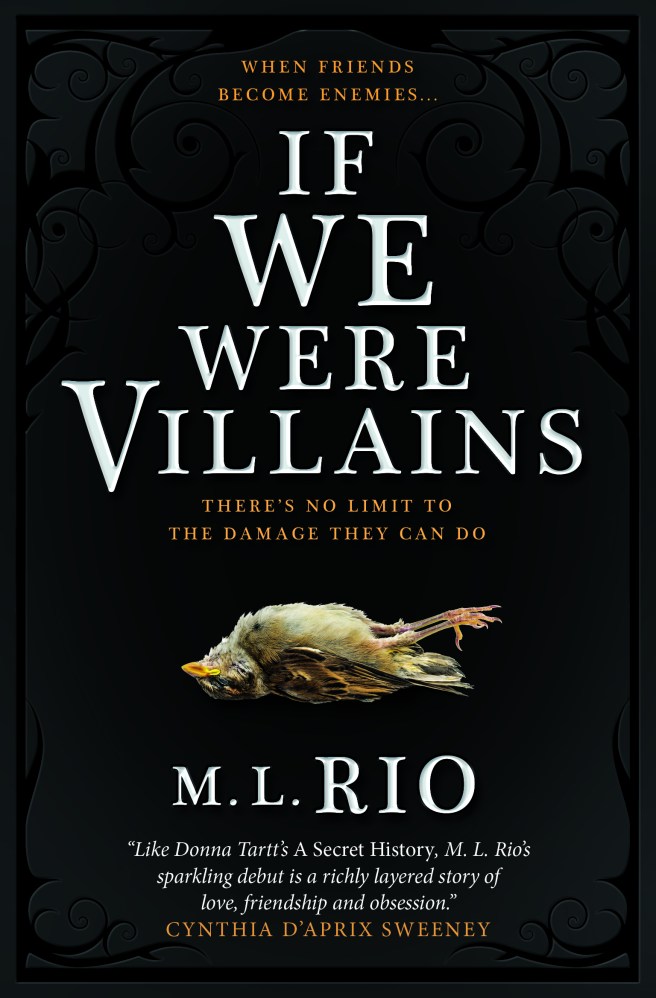
Here’s your first look at the cover art for Villains in the UK! This paperback beauty’s coming June 13th from Titan Books.
Mark your calendars.
 M. L. RIO