Writer’s Toolbox

This week in a conversation with my fellow MA students about the upcoming hellmonth of term papers and preliminary dissertation work I realized that a lot of the apps and tools and Chrome extensions I use for writing, research, and productivity aren’t necessarily common knowledge. So here, for anyone who wants it, is a collection of writer tools.

Productivity

  • Momentum: Chrome extension that helps organize your daily goals
  • Strict Workflow: Chrome extension based on the Pomodoro Technique; blocks social media to keep you focused when working online
  • Pacemaker: highly customizable tool which helps you form a plan of attack for various drafts, projects, rewriters, etc.
  • f.lux: freeware which gradually adjusts the colors on your computer screen to make working after dark easier on the eyes
  • Coffitivity: app and website which provides ambient background noise to fake that coffee-shop feeling and keep you focused
  • WriteChain: app which reminds/motivates you to write every day

Outlining & Word Processing

  • iMindMap: mind-mapping software
  • Scrivener: word processor designed for writers (who also happen to be Mac users; seriously if you’re on a PC don’t bother)
  • Evernote: online workspace which can be synced to your laptop and smartphone 
  • Final Draft: script and screenwriting software that does the formatting for you
  • Celtx: the free version of Final Draft
  • LitLift: online outlinging tool and way to keep track of all your projects

Names & World-Building

  • AutoRealm: free mapmaking software; there’s a learning curve but it’s not rocket science
  • SketchUp: 3D modeling software that helps you create imaginary buildings and keep them consistent
  • Google Earth: great for working in real-world locations
  • Stellarium: lets you get a real-time look at the night sky in any location on Earth
  • Ambient Mixer: free tool for creating custom soundscapes; or you can listen to soundscapes other people have already made
  • City and Town Name Generator: a lot of great resources here for fantasy/RPG writes but this also provides examples of real-world place names based on geographic data
  • Ever-Changing Book of Names: freeware which creates random names, also based on geographic/linguistic data; geared toward fantasy but extra sets can be downloaded individually
  • Names by Decade: US census data of popular baby names by decade

Lit Agents & Query Letters

  • QueryShark: blog run by ruthless lit agent Janet Reid who will teach you how to write a query letter, and how not to
  • QueryTracker: online directory of lit agents and agencies
  • Writer’s Marketplace: the paper version of QueryTracker
  • #mswishlist: agents open to queries and what they’re looking for
  • MSWL: a more organized website which keeps track of the above hashtag

Other

  • Calibre: free software which lets you create your own ebooks; a great way to read later drafts and look for errors on the go
  • Mendeley: for organizing research/resources if you don’t want to pay for Scrivener
  • timeanddate.com: calendars for any book you might be writing that takes place in recent history; also provides solar/lunar info
  • Dropbox: document storage so you don’t literally lose your shit

This is a very short list and I will probably expand it as other tools and tricks I use on a regular basis occur to me. But in the meantime, I hope this is useful to other writers (and grad students) out there.

Complicity

A bit of Shakespearean wisdom from Sir Ian McKellen at the Oxford Literary Festival today: the purpose of a soliloquy is to make you, the audience, complicit.

Green Eggs and Hamlet

(with my deepest apologies to Shakespeare and Dr. Seuss)

Can I kill my Uncle Claude?
Yes, I can, I can, by God!
I will kill my Uncle Claude!

Should I kill him in the house?
Should I kill him while he’s soused?
I could kill him here or there
I could kill him anywhere
Would I, could I, while he prays?
Kill him! Kill him! Wherefore stay?
I would not, could not, while he prays!

Not in the house, not when he’s soused,
Not with his sister, now his spouse!
Not while he prays, not while he feasts,
O, incestuous, adulterate beast!
I do not like my Uncle Claude,
I do not like that bloody bawd!

Say! In the dark? Here in the dark!
Would I, could I, in the dark?

Should I kill him in his bed?
Should I there strike off his head?
Kill him with his nightcap on?
Kill him when the churchyards yawn?
Should I kill him where he lies?
I will kill him, by and by!
I do not like my Uncle Claude,
I’ll kill him, i’ th’ name of God!

The play! The play! The play’s the thing!
The thing wherein I’ll catch the king!
No more ‘to be or not to be,’
I will kill him, you will see!

Kill him while he wears his crown
Kill him while his guard is down
Kill him with some poisoned wine
Kill him with this sword of mine
O, is the point envenomed, too?
I’m dead–Horatio, adieu!
But tell them, tell them, more or less,
Who it was that made this mess!

I did not like my Uncle Claude,
I killed him in the name of God!
Good friend report my cause aright–
A now, goodnight goodnight goodnight!

Production Draft!

proddraft.jpg

So, it’s been pretty quiet here for a while, and that’s because I’ve been hard at work on the last revisions for Villains. And with the help of copious amounts of coffee and five (count ’em, five) different editions of King Lear, I got my final final draft turned in to my editor today! Which means that we’re one step closer to the finish line. There’s still a lot to be done, but now that the text itself can be handed over to copy editors, we get to start talking about fun stuff like art and blurbs and rough front. More soon.

Wise Words on Writing and Hard Work from David Wong

As anybody who’s familiar with my reading habits probably knows, I love David Wong. His books are wild and off-the-wall and appeal to my sometimes infantile sense of humor and always fervent love of the macabre. I can’t say enough good things about his books. And having seen what he posted on Goodreads today, I think it’s pretty clear why.

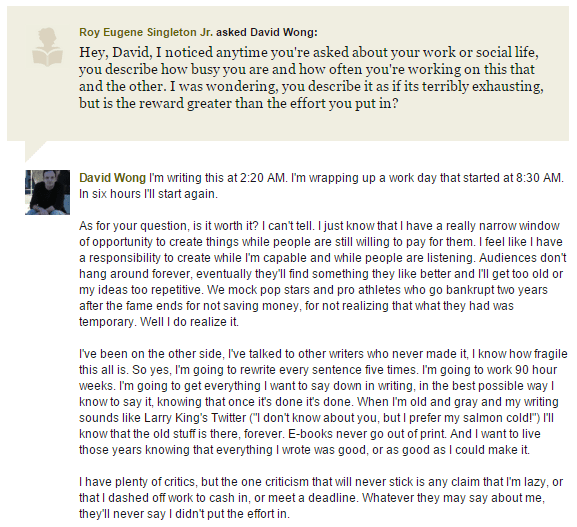
davidwong

I get a lot of questions about writing and revision and most people seem to think it’s a sort of hobby I pursue in my off hours, but that’s not at all the case. Last night I spend three hours fixing one paragraph, and that’s not remotely anomalous. Art is hard work, and I think consumers and aspiring artists forget that sometimes.

Let David Wong be an object lesson. Writing is a craft of the ‘glacier’ class: only ten percent is creative inspiration. The rest is hard, hard work.

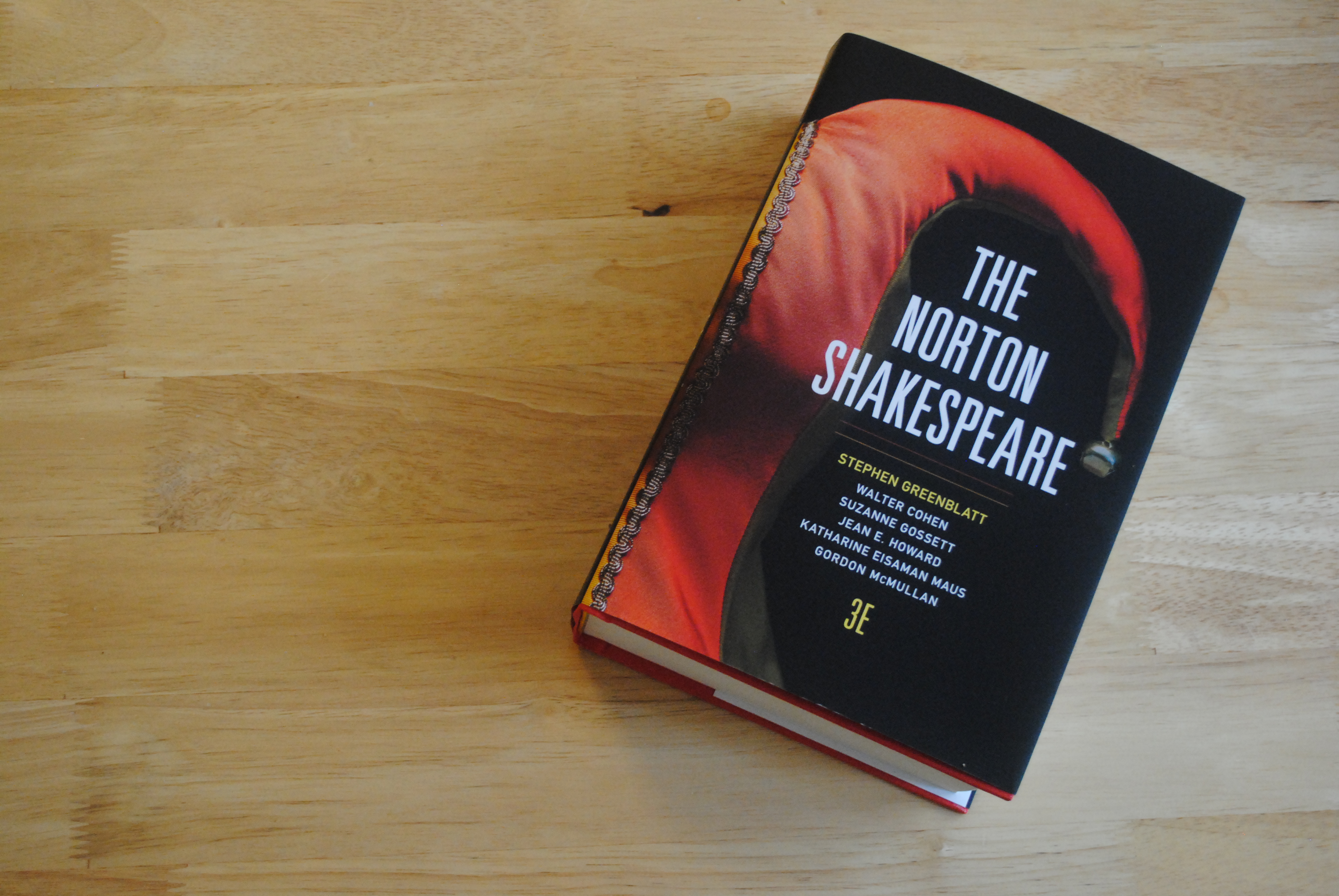
Let me tell you why the new Norton Shakespeare should be at the top of your Christmas list.

I’ve always been a Riverside girl. I spent hours with my face buried in a much beloved (and very patient) director’s copy until my parents bought me my very own to celebrate my high school graduation. I was ecstatic to find a gently used copy here in London after leaving my own at home. The Riverside–my Shakespearean security blanket–will probably always have a place on my shelf and in my heart. (We’re talking Shakespeare here. I’m allowed to be a little sentimental.)

But last night, I and the other MA candidates in Shakespeare Studies at King’s College London were invited to attend the launch party for the Norton Shakespeare Third Edition, and let me just tell you, I might be a convert. After Stephen Greenblatt (the general editor on this project and a name you should know if you’re in the Bardly business) gave us the background of this remarkable book, KCL’s very own Gordon McMullan got up to give us a digital tour. That may not sound exciting, but I and–judging by the small stifled gasps of excitement and murmurs “Oh my God, this is everything I’ve ever wanted” from the row behind me–my fellow graduate students were absolutely gobsmacked. Jaws on the floor. I’m fairly certain a few of us were on the verge of tears. Why? Because Norton has literally changed the face of Shakespeare scholarship.

DSC_0872

In his brief speech, Professor Greenblatt said something that stuck with me. To fully experience Shakespeare, he explained, you need two things: wonder and resonance. Of course, in a room full of academics resonance is paramount. We have to understand what we’re reading–not only linguistically, but culturally, historically, metaphysically, [insert adverb of your choice here]. And the new Norton edition, with textual and performance and editorial notes and timelines and illustrations and family trees amassed by an army of amazing editors, has more than made that possible. But their commitment to preserving the wonder of Shakespeare’s words is equally important. Instead of the cramped, claustrophobic two-or-three-column text we’re used to seeing in any hard copy of the Complete Works (usually printed, as Greenblatt joked, on ‘cigarette paper,’) the Norton Third Edition presents a clean page, in one column, with minimally intrusive footnotes. The Complete Works is not usually what I reach for when I want to curl up and revisit my favorite scenes of Merchant of Venice purely for pleasure, but Norton may have changed that. For the first time we have a Complete Works where the wonder doesn’t get buried by the resonance.

You might be wondering how useful such a streamlined book is really going to be. Sure, it might make for a more pleasant reading experience, but aren’t you sacrificing function for form? Luckily for us, Norton refused to make that compromise–and this is where the digital edition comes in.

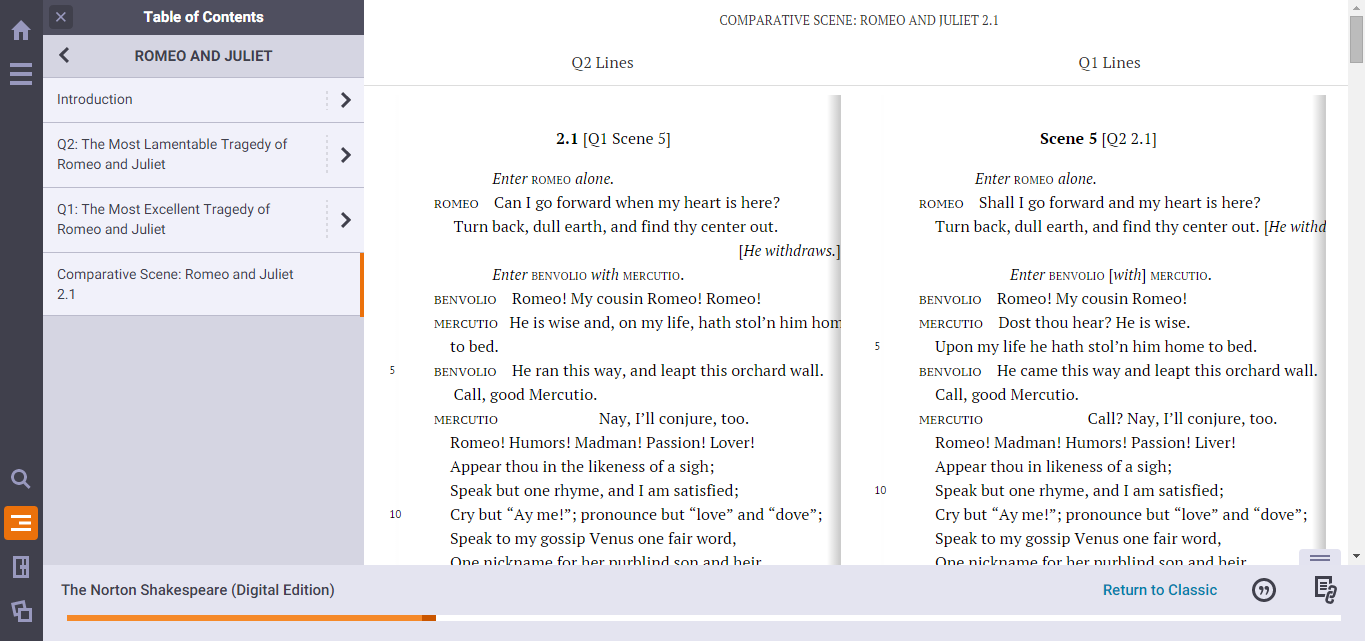
Any purchase of the Norton Third Edition includes a unique registration code to access and download the digital edition. And as someone who’s been combing through the content for the better part of four hours, let me tell you, that it is absolutely worth it. Norton has brought Shakespeare into the digital age. Of course, all of the texts have been available online since the advent of the internet, but never like this. Norton’s Bookshelf application provides the user with an absolutely dizzying array of features, all (somehow) without sacrificing that clean, beautiful interface that keeps the wonder intact. With the digital edition you get not two versions of Hamlet, but four. You can look at the different Quarto pages of Romeo and Juliet side by side. You can even click on First Folio facsimiles, voice recordings, and pertinent performance notes, all tucked neatly in the margins. You can click on troublesome words for definitions, you can take notes and place bookmarks and highlight in three different colors. Don’t want to do any of that? You can hide it all have nothing but the words on a plain white screen if you feel your wonder starting to waver.

nortoncompscene

I don’t mind admitting that I was one of those dramatically gasping graduate students. It’s difficult to explain to someone who doesn’t spend their days immersed in Shakespeare how truly revolutionary this is. It’s like having the Folger and the Globe and all their combined resources in your pocket. Something so comprehensive and exciting and easy to use is not only going to keep legions of graduate students from sobbing over their dissertations because they have to visit twelve different libraries just to access the resources they need. It’s also going to make Shakespeare accessible in an unprecedented way to a whole new generation of students and researchers and educators and theatre practitioners. The potential is unlimited.

I think it’s safe to say that Norton has done something tremendous here. They’ve not only given us Shakespeare, but they’ve given us Shakespeare for the twenty-first century, and to their eternal credit, they’ve kept both the wonder and the resonance intact. It’s a brave new world.

#TenThingsNotToSayToAWriter

This hashtag is currently trending on Twitter, and while most of the writers in the Twittersphere are using it to vent their frustration, some words of wisdom have also come up in discussion. One of the most common complaints among writers seems to be that people who don’t write assume, as soon as you identify yourself as a writer, that writing is merely a hobby–something you do because you have enough money or enough free time that you don’t have to hold a “real” job.  In my experience it’s been almost exactly the opposite. Writing is my real job, and anything else I’ve done to make money has simply served to support my fledgling career as a writer. Understandably, it’s annoying when anyone says, “So you’re not working.”

What’s most interesting to me about this discussion is the criteria the general public assigns to “real” writers. The line of inquiry to determine whether or not you’re a real writer usually goes something like this: “So you’re a writer. Anything I would have read? Why haven’t I heard of you? Can I buy it on Amazon?” Basically, unless you’ve been on a New York Times Bestseller list, you don’t get to call yourself a writer without being given the third degree on a daily basis. Someone watching the debate unfold was curious enough to ask Joanne Harris–author of Chocolat and Gentlemen and Players (a personal favorite of mine), among others–why these questions are perceived as rude. Her answer was pithy and on point:

“If someone tells you they’re a professional writer, it’s generally impolite to then assume it’s a hobby…”

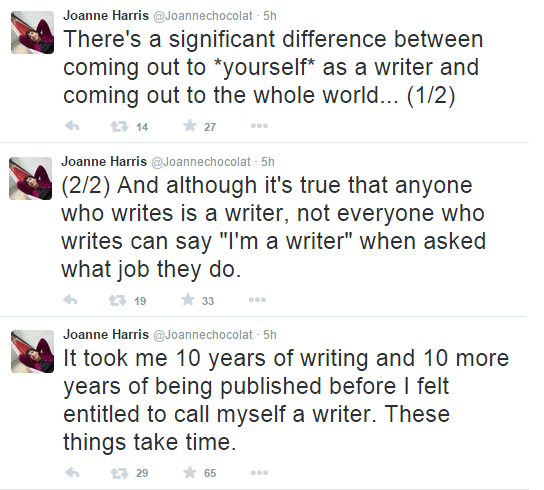
What, then, should be the benchmark for a “real” writer? Publication? Sales? Certainly there’s a difference between a published novelist and someone who’s writing Star Trek fanfiction in their spare time. But how do we make the distinction? Harris goes on to explain that it may be more complicated than Twitter has, thus far, been willing to allow. The simple act of writing doesn’t necessarily make you a writer, but you don’t have to be J. K. Rowling to call yourself a writer either. There’s a difference, she says, between learning to think of yourself as a writer, and telling other people that’s what you are:

harris

Perhaps it’s time we start approaching the term “writer” with fluidity in mind. If you write, indeed, you are a writer. It’s not unlike being an athlete–it’s something you can do and call yourself without receiving any sort of paycheck, or something you can make millions doing and add the designation of “professional” to the title. But until such a time comes when the terminology is clearer, let’s try giving writers the benefit of the doubt. If someone identifies themselves to you as a writer, it’s likely that’s they’ve gone through at least part of the process Joanne Harris is talking about. They’re confident enough in their craft to call themselves a writer, and they probably don’t do it lightly. So, if you’re curious, avail yourself of the #TenThingsNotToSayToAWriter tag on Twitter, have a good laugh, and know what questions not to ask next time you find yourself face to face with another inkslinger.